
Proven Naval Technology, Manufactured in India
CFF applies proven technology and engineering discipline to the Indian Navy's most demanding requirements — building, integrating, and sustaining mission-critical systems
CFF Fluid Control Limited was formed to bring a critical-application engineering practice — built since 1991 in exotic alloys, high-pressure fluid control and mechanical systems — to the Indian Navy under Make in India. A Transfer of Technology agreement with Coyard SAS of France, signed shortly after incorporation, applied that capability to fluid-control and mechanical systems for the Navy’s submarine construction programme, taking them into production in India — the first of a series of such absorptions.
Today CFF works with technology partners across Europe to indigenise naval systems across the mechanical, electrical and electronic, underwater communication, acoustic, and weapon and sensor domains — supplying India’s warship and submarine builders and supporting the platforms they deliver. Each partnership began with an audit of CFF’s processes, quality systems and traceability; in every case, they approved a manufacturer that already existed.
From in-house design and precision manufacturing, through testing, qualification, installation and commissioning, to refit and through-life support, CFF is present in every phase of the platform’s life.
250
+
Qualified Engineers and professionals
2
Production facilities
8,000
sq. m
Combined manufacturing establishment
3
Technology Partners
Surface Combatants
Delhi class Nilgiri class Visakhapatnam class Kamorta class Anti-Submarine Warfare Shallow Water Craft Survey Vessel (Large)
Submarines
Kilo class Shishumar class Scorpene class
The capability came first.
CFF's naval work rests on a critical-application engineering practice built up since 1991 — sourcing, forging, welding and machining exotic alloys to the acceptance standards of the power, oil & gas, aerospace and defence industries. The engineers who built that practice are the team that builds CFF today. When Europe's naval technology houses audited CFF — inspecting its processes, quality systems and traceability — they were confirming a manufacturer that already existed.
1991
Engineering practice established
400
bar
Mechanical & High Pressure Systems
5
EKM
AC augmentation inhouse re-engineered in titanium
500
+
Titanium Air bottles for Akash Missiles
Materials & Exotic Alloys
Nickel-aluminium bronze, titanium, stainless, duplex and super duplex, Hastelloy, Inconel and nickel alloys — forged, welded and machined to specification.
Titanium fittings and valves
Lead-kentledge ballasting for foreign submarine programme
In-house-designed titanium air bottles for the Akash surface-to-air missile, type-tested and supplied to the Defence Research & Development Laboratory.
Five EKM-class submarines AC chilled-water system augmented in titanium — including exhaust trunking, water-collecting tank, dual-walled piping and fittings. That depth reaches the hardest work in the country.
02
High-Pressure Fluid Control
It is the reason the word in the company's name is control.
03
Process & Pressure Equipment
An ASME “U”-stamp practice — forging, forming, water-jet cutting, plate and tube bending, CNC machining and full testing. Titanium-tubed air-cooled heat exchangers for the chemical and oil & gas majors; IBR- and ASME-approved turnkey piping for power, marine and process plants.
04
Precision Across Sectors
Waste-heat turbo scrolls running at 360–460 °C and lube-oil coolers for the railways. The turbocharger and oil-cooler assemblies for the T-90 main battle tank are designed completely in-house. Development of aerospace heat exchangers, pipe fittings, air bottles and engine sub-assemblies — including air-to-air and shell-and-tube heat exchangers.
05
In-House Design & Qualification
Thirty-one variants of water-tight and fire-safe doors and hatches, each type-approved by the Directorate of Naval Architects — IHQ Navy, designed in-house through mechanical design, finite-element analysis, and stress and structural analysis, and built to the governing naval standards, with defence-application weld qualification.
India did not miss its maritime moment. It was interrupted.
Centuries of deliberate de-industrialisation dismantled what India had built over millennia. The Lothal dockyard on the Gujarat coast — the world's earliest recorded maritime facility — dates to 2500 BCE. The Chola naval arm was the largest battle fleet in pre-modern Asia. Kanhoji Angre denied the Konkan coast to every European power that contested it. The capability was always here.
CFF Fluid Control Limited is among those reinstating it.
INDIGINEERING.
Absorbing world-class technology and manufacturing it in India to the same standard as the country that developed it — so that each successive programme needs less from abroad.

This is a precise statement, not a slogan. It contains four obligations that CFF takes seriously:
Absorb
not procuring, not assembling, not just holding a licence. Understanding the engineering, mastering the process, owning the manufacture and quality system.
Manufacture
not a cost-reduced variant, not an India-adapted substitute. The same acceptance criteria as the component leaving the technology partner’s country.
Indigenise
Each successive programme needs less from abroad: the indigenisation deepens with every contract cycle. P75I goes further than P75 Scorpene. P76 goes further still.
Originate
Building on absorbed technology, to design the next generation of systems in India.
Our Journey
Indigenous engineering capability, built into a listed Naval Systems company — component by component, programme by programme.
Our place in India's naval supply chain
Platform qualifications span all three operational submarine classes and the principal surface combatant programmes.
SUBMARINE PLATFORMS
| Programme | Class / Designation | Status |
|---|---|---|
| Kilo Class | Type 877 EKM · Sindhughosh class · 8 boats | DELIVERED |
| HDW SSK | Type 1500 · Shishumar class · 4 boats | ACTIVE REFIT |
| P75 Scorpene | Kalvari class · 6 boats commissioned · MDL | DELIVERED + ACTIVE REFIT |
SURFACE COMBATANTS
| Programme | Class / Shipyard | Status |
|---|---|---|
| P17 | Shivalik class guided missile frigates · MDL · 3 | DELIVERED |
| P15A | Kolkata class destroyers· 3 at MDL | DELIVERED |
| P15B | Visakhapatnam class destroyers· MDL · 4 | DELIVERED |
| P17A | Nilgiri class frigates· 4 at MDL and 3 at GRSE · 7 | ACTIVE |
| P28 | Kamorta class ASW Corvette · GRSE · 4 | DELIVERED |
| ASW SWC | Shallow Water Craft · 8 each at GRSE and CSL | ACTIVE |
| SVL | Survey Vessel (Large) · 4 at GRSE | ACTIVE |
Future
| Programme | Lead OEM / Status | CFF Position |
|---|---|---|
| P75I | TKMS · Pipeline programme | Qualified through past submarine track record and New Systems based on Engineering depth currently being built. |
| P75(AS) | Naval Group · Pipeline programme | Engaged from the design phase Qualified through P75 Scorpene supply |
| P76 | Indigenous submarine programme · Pipeline | Qualified through past submarine track record New Systems based on Engineering depth currently being built |
| P17B | Next Generation Frigate · MDL + GRSE · 8 ships | Qualified through P17, P17A, P28 and ASW SWC supply Building engineering depth for new systems |
| NGC | Next Generation Corvette · GRSE · 8 ships | Qualified through P17, P17A, P28 and ASW SWC supply Building engineering depth for new systems |
| NGMV | Next Generation Missile Vessel · CSL · 6 ships | Qualified through P17, P17A, P28 and ASW SWC supply Building engineering depth for new systems |
| P18 / NGD | Next Generation Destroyer · 5 ships | Qualified through P17, P17A, P28 and ASW SWC supply Building engineering depth for new systems |
Facilities
Facilities are certified and operate to the acceptance standards of the Indian Navy , international defence-manufacturing codes and CFF's technology partners.
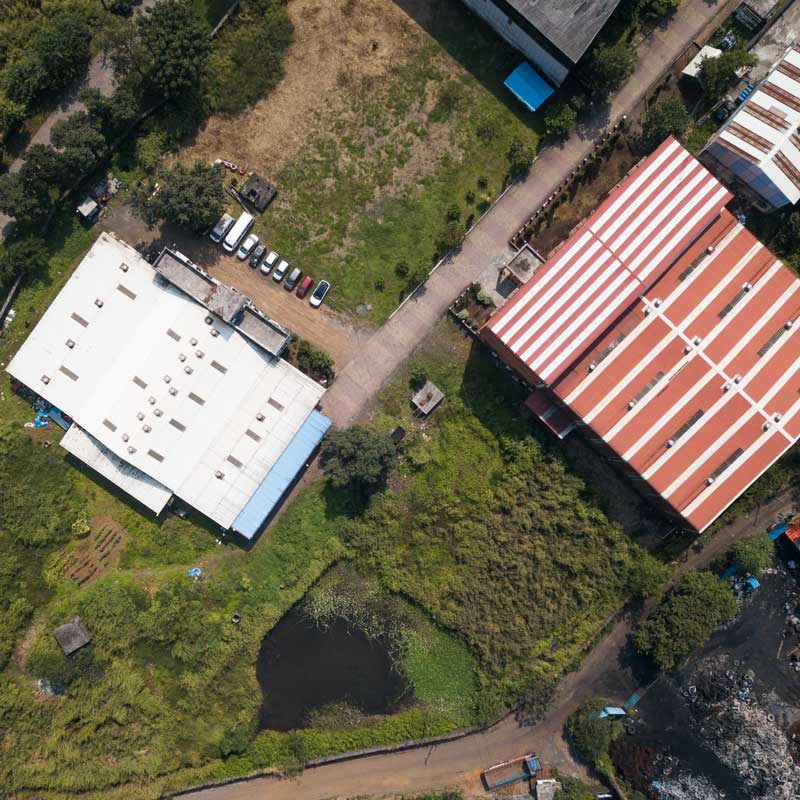
Khopoli, Maharashtra
Mechanical manufacture and platform systems
CFF’s first manufacturing facility. Khopoli carries the mechanical content of CFF’s work — high-pressure air and Hydraulic systems, manufacture and functional testing, atmosphere management and HVAC assembly, steering gear, infrared suppression, exhaust systems and fire fighting systems.
Full Factory Acceptance Trial capability is available on site.
Chakan, Maharashtra
Electronic manufacture and assembly
Established in August, 2024 and purpose-built for electronic manufacture and assembly alongside mechanical manufacture. Chakan carries the electronic content of CFF’s work — weapons systems, sonar systems, signal processing, special sensor production.

2
Manufacturing facilities
7
Customer Sites
8,000
sq. m
Combined footprint
ISO 9001:2015
Certified Facilities
Design & Engineering
CFF is not a production-only facility. The engineering team translates customer requirements —studying Naval and Defence specifications, conceptualising, designing and manufacturing to those exacting requirements, adapting foreign OEM systems to Indian platform interfaces, resolving integration challenges that emerge in Naval Dockyard environments —and works with technology partners to further develop and indigenise successive generations of each system.
This design-and-engineering function is what distinguishes a manufacturer from an assembler,and what makes the Transfer of Technology real rather than documentary.
The engineers being trained at Khopoli and Chakan today are the engineers who will work on P76.
Leadership
The Board of Directors of CFF Fluid Control Limited.

Gautam Makker
Chairman and Non-Executive Director
Gautam Makker is a Founding Promoter of CFF Fluid Control Limited and has been associated with the Company since its inception. He was designated Chairman and Non-Executive Director on 30 September 2022. He holds a Bachelor’s degree in Electrical Engineering from Poona University and has over 27 years’ experience in strategic sourcing and solution delivery across the defence, marine and power sectors. He guides the Company’s long-term strategy and technology partnerships.
Committees: Stakeholders Relationship; Nomination & Remuneration; Corporate Social Responsibility.

Sunil Menon
Managing Director
Sunil Menon is a Founding Promoter of CFF Fluid Control Limited and has been associated with the Company since its incorporation. He was designated Managing Director on 30 September 2022. He has over 30 years’ experience across the defence, engineering and industrial sectors. He holds a Diploma in Hotel Management from the Board of Technical Education, Delhi — a grounding in operations, service delivery and institutional management that he carried into the defence domain at the start of his career. Under his direction the Company has grown from a component manufacturer into a systems house serving the Indian Navy and its shipyards, and has extended its work into system integration across defence platforms. He leads the Company’s business strategy, international partnerships and technology direction.
Committees: Chairman — Corporate Social Responsibility; Member — Audit.

Rajnish Prakash
Non-Executive Independent Director
Rajnish Prakash has served on the Board since 30 September 2022. He holds a Bachelor’s degree in Chemical Engineering from the University of Roorkee (now IIT Roorkee) and a Postgraduate Diploma in Chemical Engineering (Reaction Engineering) from IIT Delhi. He spent his career with the Department of Atomic Energy, Government of India, where his roles included Chairman and Chief Executive of the Heavy Water Board and Chairman of the Atomic Energy Education Society. He has also served as an Independent Director of Nuclear Power Corporation of India Limited. His honours include the INS Homi Bhabha Lifetime Achievement Award and the Outstanding Engineer Award of the Institution of Engineers (India).
Committees: Chairman — Audit; Member — Stakeholders Relationship; Nomination & Remuneration; Corporate Social Responsibility.

Priyanka Moondra Rathi
Non-Executive Independent Director
Priyanka Moondra Rathi has served on the Board since 2 September 2022. She holds a Bachelor of Commerce degree from Jai Narayan Vyas University and a Diploma in MBA (Finance) from the International Business Management Institute, Berlin. She is a member of the Institute of Company Secretaries of India and is pursuing the Certified Public Accountant (CPA) qualification. She has over five years’ experience in secretarial practice, legal compliance and corporate governance. She is associated with Transmissions International India Private Limited and is a Partner at Priav Eduserve & Consultancy LLP.
Committees: Chairman — Stakeholders Relationship; Nomination & Remuneration; Member — Audit.